$\,$ Background $\,$
BSc
- BSc undergraduate degree in physics, University of Crete (2018-2022)
- Research work in theoretical HEP, at CCTP (Holographic RG flows on the deformed $\mathcal{S}^3$ manifold)
- Research work in cosmic-ray phenomenology, at IA/FORTH
- Thesis: "Cosmic-ray air-shower simulations across the ankle: Combining mixed Galactic composition with new physics above 50TeV", Supervisor: Prof. V. Pavlidou
MSc
- MSc graduate degree in physics, Specialization in astrophysics & space physics, University of Crete (2022-2023)
- MSc internship at IA/FORTH & CosmoStat
- Thesis: "Comparison of mass-mapping techniques using weak gravitational lensing. Application to the UNIONS galaxy survey", Supervisor: Dr. J-L. Starck
PhD
- PhD graduate degree in physics, University of Crete (2023-ongoing)
- Topic: "Weak Lensing Mass Mapping and Cosmology Inference"
PhD Research
$\,$Introduction - Weak Lensing$\,$
- WL = Observational technique in cosmology for studying the matter distribution in the universe
- Principle: deflection of light from distant galaxies by gravitational fields → causes image distortion
- Weak → subtle & coherent distortions of background galaxy shapes
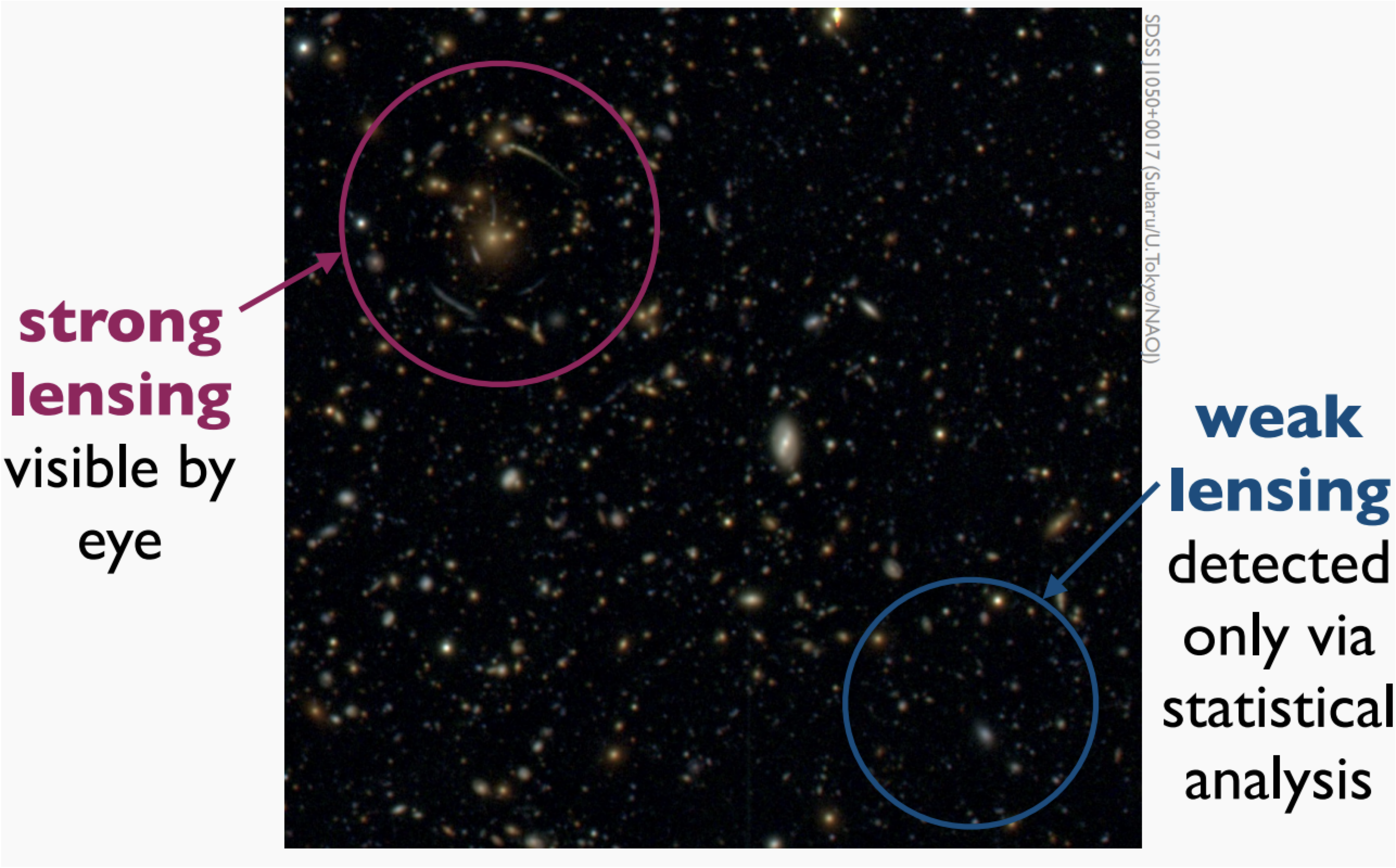
- WL provides a direct measurement of the gravitational distortion.
- WL enables us to probe the cosmic structure, investigate the nature of dark matter, and constrain cosmological parameters.
From galaxies to mass maps
Objectives
Contribute to
weak-lensing cosmology by:
- Developing novel data-driven approaches for the robust reconstruction of weak-lensing mass maps across different redshift bins, based on physical modeling, DL, and Bayesian methods,
- Introducing and exploring novel higher-order statistics for the analysis of these maps,
- Using likelihood-based and likelihood-free inference methods to produce cosmology constraints from weak-lensing observations and test different models of cosmology,
- Applying these methods to to observational data.
These objectives are especially important for exploiting the large-scale datasets from contemporary surveys like CFHTLenS, HSC, DES, UNIONS, KiDS, and the recently launched Euclid mission.
Challenges
Some of the challenges that the project tackles are:- Ill-posed inverse problem: Converting galaxy shears to convergence maps is an ill-posed problem due to shape noise and data gaps, requiring sophisticated reconstruction techniques.
- Lack of Higher-Order Statistics Predictions: Unlike 2pt statistics, higher-order statistics lack precise theoretical predictions, necessitating extensive numerical simulations.
- Computational Demands: Mass mapping and statistical inference are computationally intensive, needing efficient algorithms and high-performance computing resources.
- Systematic Effects: Addressing intrinsic alignment, baryonic effects, and survey masks is crucial for accurate cosmological inference.
- Data Processing and Analysis: Handling the vast and intricate datasets from current and upcoming surveys, such as Euclid, demands sophisticated computational strategies for meaningful cosmological analysis.
Current Projects
Create a pipeline:
- Use it to investigate the impact of mass mapping algorithms on cosmology constraints.
- Use it on UNIONS/CFIS data to get observational constraints on cosmology.
- Use it for testing the novel mass-mapping algorithms that we develop.
Example results
- Example of the first non-KS UNIONS mass maps
- The choice of mass mapping method has a significant impact on the final
cosmological constraints
- Employing more advanced methods for the mass-map reconstruction can increase the precision of the constraints on cosmology from observational data